


Creating an Intentional Holiday In-Store Experience From audio messaging to visual displays, seasonal takeovers can transform the in-store experience—when every element works together. Barry McPhillips, Head of Creative at Mood Media, explains why your holiday...

Bridging the Memorability Gap: When Hotel Atmosphere Becomes a Financial Asset
By Jeff Cottom, Mood Media
When a stay is comfortable but completely uninspiring, it introduces a hidden vulnerability to your asset portfolio. Hotel sensory branding is the key to a better guest experience.
What You’ll Learn in This Guide: The Three Rs
The Risk
A silent, scentless lobby is an unremarkable one, turning guests into one-time visitors with little else to remember your brand.
The Research
The human brain processes sensory media beyond what their eyes first tell them, enhancing their experience by measurable differences.
The Return
Making the hotel atmosphere an interconnected asset optimizes the financial yield of every square foot.
When I consult with multi-unit franchise owners and enterprise brand directors across North America, I notice a common theme. Franchisees pour immense capital into meeting strict corporate brand standards—investing heavily in visual design, premium reception furniture, and beautiful lighting installations. Owners are the heroes of their properties’ stories, fighting daily to maintain quality scores and protect their asset’s valuation.
But an invisible villain can work against owners in their own lobbies.
If a franchise property looks great but feels silent and sterile, it is falling into the Memorability Gap. When a physical space lacks sensory energy, it leaves zero emotional footprint. The moment a guest checks out, the memory of that stay evaporates.
When a physical space lacks sensory energy, it leaves zero emotional footprint.
In other words: If your property is boring, guests will forget you the second they check out.
The next time those same guests travel, they won’t feel drawn to your franchise flag to book directly. They will go straight to a third-party online travel agency (OTA) like Expedia or Booking.com and purchase whatever room is cheaper.
Franchise networks shouldn’t have to surrender their hard-earned profit margins to high OTA commissions or generic price wars.
Closing the Memorability Gap is key to winning the day with guests and their preferences. Working with leading hospitality brands, we’ve identified a framework that can help owners reclaim guest relationships by treating their physical real estate as an active profit center.
1. The Risk: Property Without Personality
In the modern travel landscape, cleanliness and comfort are no longer differentiators; they are basic baseline expectations.
Guest expectations have evolved. If a property competes strictly on the physical parameters of a room—bed comfort, square footage, bathroom cleanliness—it is playing a transactional game with little to no emphasis on long-term customer retention.
The Transit Station Effect
When a hotel lobby acts merely as a quiet, sterile passageway to an elevator, guests treat it like a transit station. They bypass your common spaces, go straight to their rooms, and spend their ancillary dollars outside your property.
Nice-looking hotel rooms are a commodity; an unforgettable lobby atmosphere is a profit center.
The Risk
The Hidden Financial Toll: By leaving your lobby atmosphere empty, you drop your Total Revenue Per Available Room (TrevPAR). You force your marketing budget to work twice as hard. Because the stay leaves no distinct sensory memory, you are forced to pay a heavy commission back to the OTAs just to win that same guest a second time, eroding franchise profitability.
2. The Research: The Science Behind Sensory Branding
How Does Sensory Design Impact Hotel Brand Loyalty?
Human beings do not fall in love with property logistics; we fall in love with how a space makes us feel. While visual decor forms the initial touchpoint of luxury, static digital signage and inputs are highly vulnerable to simply being ignored. A traveler sees thousands of images a day; the memory of your lobby’s intended points of attraction is easily overwritten by a single glance at their smartphone screen.
Dynamic hotel sensory branding experiences can help anchor a brand space more permanently into a guest’s long-term memory. Scent, sound, and responsive visuals operate on a direct path to the human nervous system.
How Sensory Media Anchors Long-Term Recall
When we look at the empirical data surrounding environmental programming, the science reveals a significant triad of operational leverage:
Aromatic Architecture
Scent data entirely bypasses the brain’s analytical filters, traveling directly to the limbic system—the region of the brain dedicated to memory, associative learning, and deep emotion. Distributing a custom ambient scent profile uniformly through the central HVAC builds an immediate subconscious layer of safety, luxury, or other impressions you may want to infuse into a hotel environment.
Musical Memory
Generic loops that cause fatigue can dull the sense of enjoyment and belonging, but dayparting of sound architecture can match the natural energy shifts of the day. Neurobiological data proves that slow-tempo rhythms (below 80 BPM) activate the parasympathetic nervous system, lowering heart rates and making guests feel calmer. This intentional music program expands physical dwell time significantly.
Visual Velocity
Traditional static signage blends into the background, but digital signage networks capture 400% more views. By displaying contextual, high-definition content loops—such as promoting an on-property wellness amenity or displaying hyper-local partner features—you capture attention at the exact point of decision. Furthermore, interactive and dynamic screens reduce a guest’s perceived wait time by up to 35%, removing operational friction before they ever register their room key.
The Research
Metrics that Matter:
%
Scent: The human brain retains olfactory data with an incredible 65% accuracy after an entire year, compared to just 50% for visuals after three months (Sense of Smell Institute).
%
Sound: Slower music tempos extend on-property stay duration by 25% to 40%, driving up to a 40% increase in premium beverage sales (Behavioral Sciences / Milliman Data).
%
Sight: Digital signage content generates an 83% message recall rate, outperforming standard print advertising by over 500% (Nielsen / Rise Vision Data).
3. The Return: Reaching the Revenue Victory
When your hotel environment feels alive, warm, and welcoming, consumer behavior shifts instantly. Guests don’t hurry through the lobby to escape to their rooms. They linger. They open their laptops in your common spaces. They sit at the bar.
This behavioral shift can be the pinnacle of your story. It is where your atmosphere directly impacts your balance sheet. By extending on-property dwell time, you automatically open the door for high-margin ancillary revenue.
Expand the Experience
When a guest spends an extra 20 minutes in an expertly curated lobby lounge, they buy the premium cocktail, order the small plate, or book a treatment at your wellness spa.
The Revenue Lift
Internal consumer research confirms that harmonized environmental design extends dwell time, which correlates directly with a 10% to 20% average lift in food, beverage, and retail conversions.
Atmosphere as an Asset: The Power of a Unified System
For franchise brands, greater operational return is realized when music, digital signage, and scent are no longer treated as separate, fragmented point-solutions. If a franchisee is sourcing music from one vendor, scent from another, and managing digital screens via localized hardware, the guest experience fractures. The “vibe” goes out of sync, corporate compliance becomes impossible to enforce, and on-site staff waste valuable hours troubleshooting mismatched systems.
Integrating these elements to operate as a singular, holistic ecosystem is essential for a hotel Atmosphere as an Asset to truly be realized.
Sensing and scaling these services directly across your specific hotel environments—from lobbies and lounges to bars and spas—is what bridges the gap between passive real estate and active revenue potential.
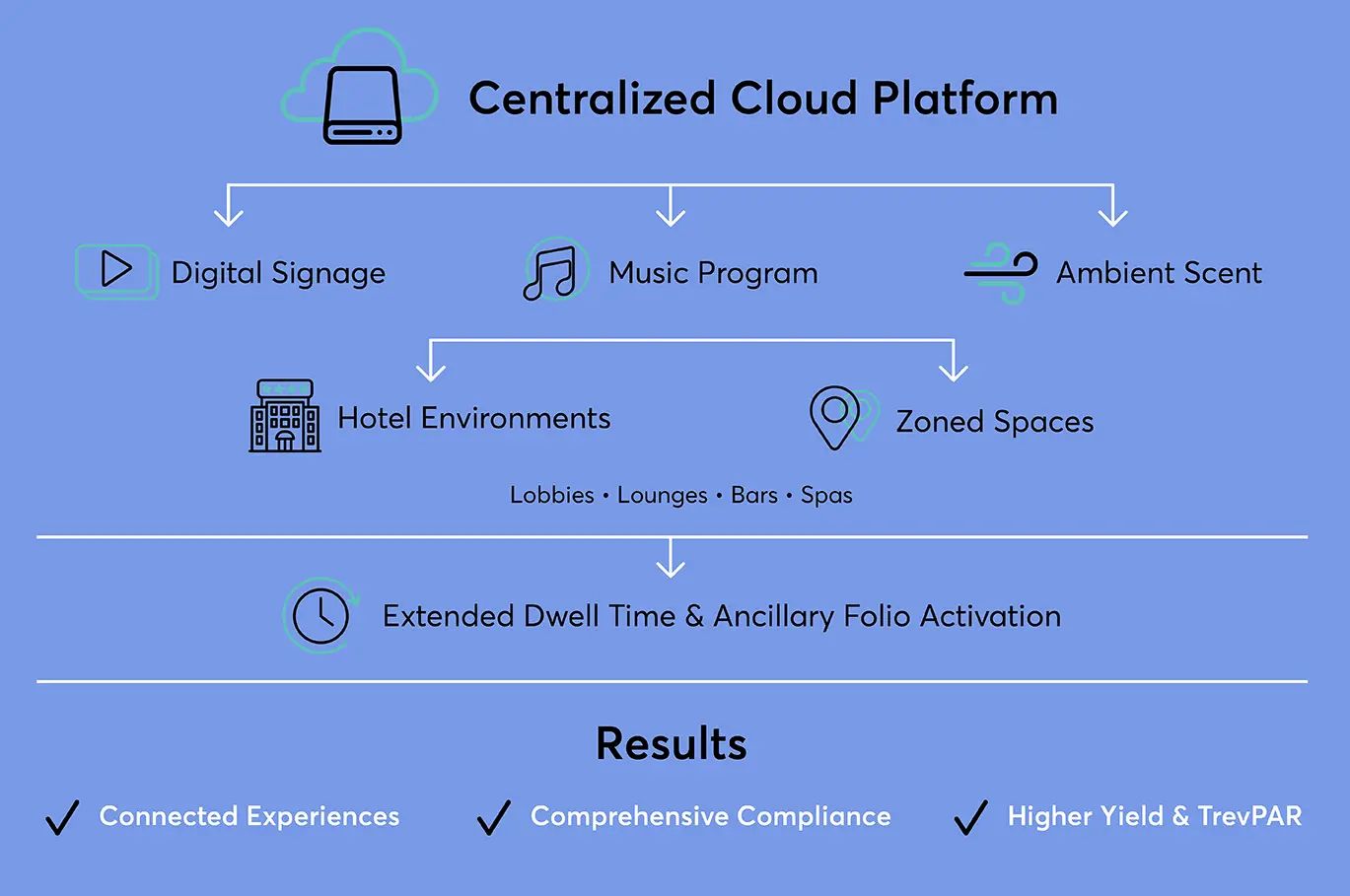
THE UNIFIED SYSTEM APPROACH
Centralized Cloud Platform
Digital Signage
Music Program
Ambient Scent
Hotel Environments
Zoned Spaces
Lobbies • Lounges • Bars • Spas
Extended Dwell Time & Ancillary Folio Activation
Results
Connected Experiences
Comprehensive Compliance
Higher Yield & TrevPAR
When background music programs change to an upscale evening tempo, the digital signage can instantly shift its visual color palette to match, while the HVAC scent diffusion scales subtly to complement the mood.
By consolidating this entire infrastructure under a single global vendor partner, franchise networks unlock two massive advantages:
Flawless Brand Compliance
Corporate teams can push dayparted sensory updates across hundreds of properties instantly, ensuring a consistent brand standard from New York to Vancouver.
Operational Efficiency
Franchise owners lessen vendor disparities, reduce local IT friction, and optimize the financial yield of every square foot—all while liberating frontline staff to focus entirely on face-to-face guest hospitality.
The Return
The Executive Takeaway: Atmosphere is a performance multiplier. Managing it through a single, interconnected platform guarantees brand compliance across your entire franchise footprint while directly accelerating property appraisal value and long-term TrevPAR performance.
Experience as the Operating System
Bridging the memorability gap—making a hotel unforgettable—is a core commercial imperative for the modern franchise network. When the property’s atmosphere is treated as a dynamic, fully integrated program, it effectively moves the business out of the volatile and low-yield commodity market.
By designing and implementing an intentional, multi-sensory environment managed through a unified platform, hotels gain a permanent competitive edge. Brands that empower franchisees this way can drive revenue, deliver authentic comfort guests are looking for, and secure sustainable margin performance that can lead the industry.
Accelerate Your Property’s Performance
Balancing strict corporate brand standards with local asset profitability requires advanced, enterprise-grade infrastructure. Centralizing your internal media ecosystem protects your global brand equity while giving your property teams the exact tools they need to engage their unique markets.
Ready to inspire your guests and protect your footprint?
Jeff Cottom
Jeff Cottom is Vice President of Global Account Management for Mood Media. He has worked with leading brands in the hospitality, property management, retail, and fast casual industries for more than 20 years. As a thought leader with global market exposure, he provides extensive insights into innovative media and sensory solutions to help clients elevate their guest experience.
CONNECT WITH US
Elevate your Customer Experience through the power of Mood.